April 01 , 2026
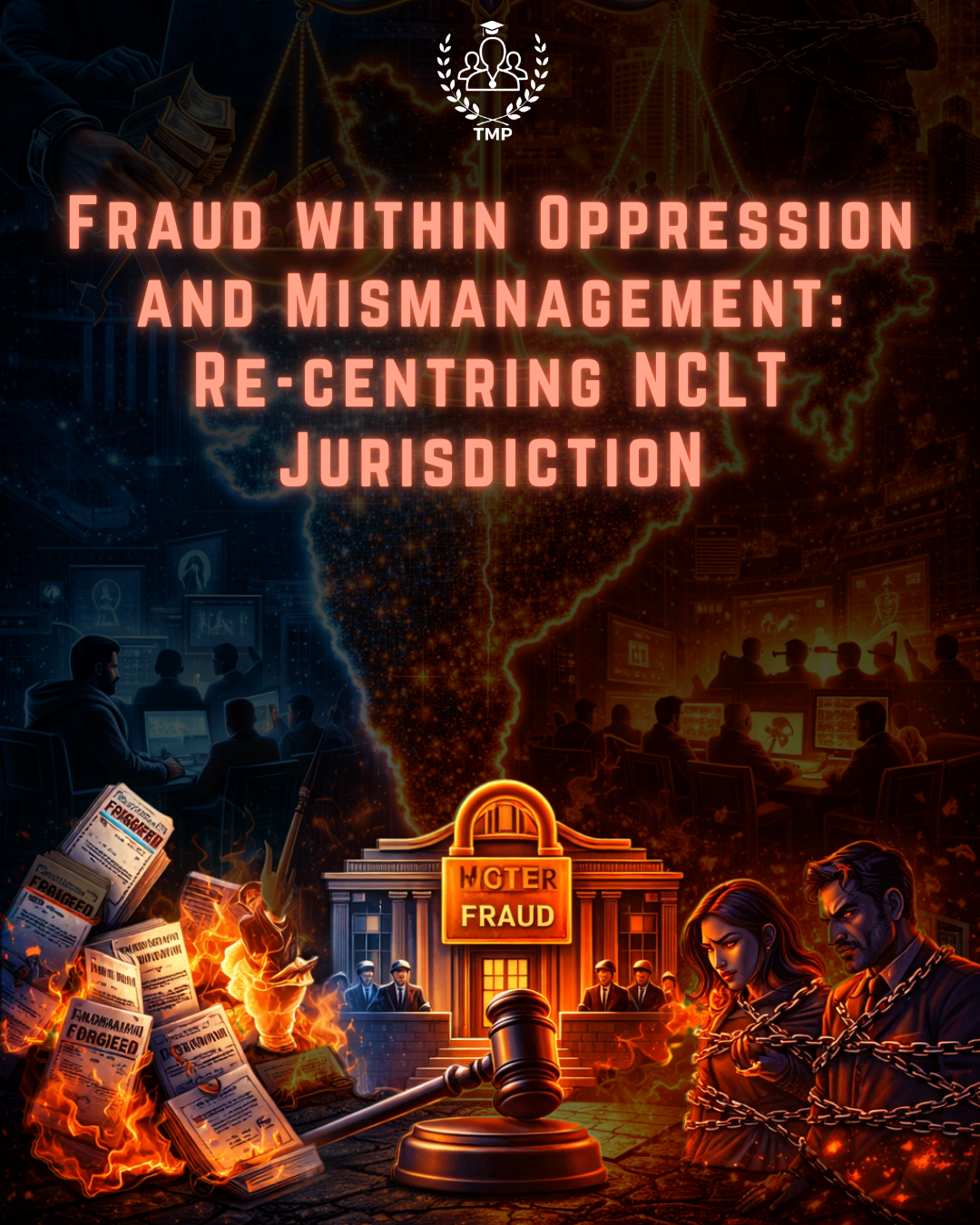
Fraud within Oppression and Mismanagement: Re-centring NCLT Jurisdiction
Fraud within Oppression and Mismanagement: Re-centring NCLT Jurisdiction
A Commentary on Shailja Krishna v Satori Global Ltd (2025 INSC 1065)
In Mrs Shailja Krishna v Satori Global Limited & Ors[1], the Supreme Court has addressed a recurring yet often misunderstood question pertaining to the Indian Corporate Law, whether the NCLT can examine allegations of fraud especially when they arise as an substantial part of a petition for oppression and mismanagement under Sections 241 and 242 of the Indian Companies Act, 2013 (“CA, 2013”). The act adopts a broad understanding of fraud, extending to include any acts, omissions, concealment, or abuse of position intended to deceive or cause harm, gain an undue advantage, or harm the interests of the company or its stakeholders, regardless of whether any actual gain or loss occurs.[2] The Court gives its answer in affirmation and holds that the NCLT possesses both the power and the duty to adjudicate such issues when the allegations are inseparable from the corporate dispute before it. The practical impact of the decision is such that it has expanded the jurisdiction of the Tribunal to adjudicate issues that were previously excluded.
Sections 241 and 242 of CA, 2013, provides the NCLT with the jurisdiction to deal with affairs of a company,[3] when they are being conducted in a manner oppressive to any member or prejudicial to the interests of the company or of the public.[4] Notably, the tribunal has a wide remedial discretion to pass such orders as it thinks fit 'with a view to bringing to an end the matters complained of'.[5] The breadth of the provision lies in its ability to enable the Tribunal to provide reliefs that resolves the underlying corporate dispute comprehensively.
The equitable character of this jurisdiction has long been affirmed by judicial precedents, both domestic and international. Oppression is not confined to conduct that is formally illegal. It further extends to a conduct that is burdensome, harsh, or lacking in probity as established by English and Scottish courts.[6] Even where corporate procedure is complied with, in form, accountability may be absent in substance and Sections 241 and 242 are designed to address this gap.[7]
Notwithstanding this framework, a jurisdictional lacuna has emerged in the overall jurisprudence. Where allegations of fraud or forgery were made by either of the parties, the Tribunal was characterised as exercising a summary jurisdiction and therefore not best suited to adjudicate such issues. Petitioners were routinely directed to civil courts, separating what was in substance, a single dispute. The oppression petition would remain before the NCLT, whilst the very acts constituting oppression were tried in a different forum, namely civil courts, thereby leaving aggrieved shareholders without a single forum capable of granting comprehensive relief and, in practice, prolonging adjudication as allegations of fraud were required to be determined separately. It is against this background that the Supreme Court's intervention in Shailja Krishna assumes its jurisprudential significance.
I. Facts of the Case
The dispute arose within a closely held family company, Sargam Exim Private Limited, which was subsequently renamed as Satori Global Limited, which is the Respondent in the present case. The Appellant, Mrs. Shailja Krishna, held approximately 98 per-cent issued shares. In December 2010, two important events occurred on the same day, namely her resignation as a director, and her entire shareholding being transferred to her mother-in-law, Mrs. Manjula Jhunjhunwala, by way of a gift deed. This happened during an ongoing marital dispute, as divorce proceedings were already in progress.
The Appellant contended that the gift deed was obtained by fraud and coercion, and that she had been induced to sign blank documents, which were later converted into instruments of transfer. She further argued that the board meetings of December 15th and 17th, where her resignation was accepted along with the induction of new directors, were convened without lawful & proper notice and without the necessary quorum as prescribed by the Articles of Association of the Company. She further alleged that the share transfer forms were tampered with and utilised beyond their statutory validity period.
The Tribunal accepted these contentions, and held the gift deed and share transfer to be void, and restored the Appellant to her earlier position as a shareholder and Executive Director. However, the NCLAT overturned this order, not on merits, but on a preliminary jurisdictional objection. It held that the allegations of fraud and forgery fell outside the jurisdiction of the Tribunal and were better suited to be tried before civil courts. The question that came before the Supreme Court was thus not simply whether fraud had been committed or not, but whether the NCLT was competent to try the case.
II. The Jurisdictional Question
The NCLAT's restrictive approach rested upon a characterisation of the NCLT's powers as summary in nature. On this basis, it was contended that allegations of fraud, requiring detailed factual inquiry, were only triable before civil courts, pursuant to the jurisdiction to cancel instruments under Sections 31 and 34 of the Specific Relief Act, 1963.[8] This line of reasoning is flawed at its core, as it blurs an important distinction between how a tribunal conducts its proceedings and what it is actually empowered to decide upon.
Quasi-judicial tribunals similar to NCLT across various areas of law routinely determine complex factual disputes, often with greater efficiency than civil courts. The flexibility in how tribunals conduct its own proceedings is part of their design, and it does not limit what they are capable of deciding. To treat it otherwise is neither supported by the statutory framework and nor with the broader jurisprudence governing tribunal jurisprudence.
A further difficulty with the NCLAT’s approach lies in its implicit assumption that the complexity or seriousness of an allegation justifies excluding it from the Tribunal’s jurisdiction. If accepted, this would lead to an unwanted paradox, the more serious the misconduct, the less able the Tribunal would be to address it. In effect, a shareholder alleging oppression through fraudulent conduct would first be required to establish fraud before a civil court as a condition precedent to the NCLT examining the oppression claim. Such a situation, which has no basis in the statute, creates a jurisdictional vacuum in which no single forum can grant a comprehensive relief and runs contrary to the object and purpose of the Act.
III. Doctrinal Foundations
The Supreme Court's reasoning in Shailja Krishna builds upon a consistent line of authority providing for a purposive construction of the Tribunal's jurisdiction.
The NCLT’s power to deal with allegations of fraud is neither new nor out of the ordinary; it is supported by a consistent line of judicial decisions even prior to Shailja Krishna. In Ammonia Supplies Corporation (P) Ltd v Modern Plastic Containers (P) Ltd, the Supreme Court clarified that merely alleging fraud does not take a matter outside the jurisdiction of the company court. What is relevant is whether the allegation is genuinely complex and central to a civil dispute, or whether it is raised simply to shift the matter to another forum.[9] This approach was further developed in Chalasani Udaya Shankar v Lexus Technologies Pvt Ltd, where the Court emphasised that the Tribunal must examine the substance of the allegation and determine whether it is serious and bona fide, rather than a tactic to avoid its jurisdiction.[10] The focus, therefore, is not on the presence of a fraud allegation, but on its nature and relevance to the relief sought.
This position is reinforced by Section 430 of the Companies Act, 2013, which significantly limits the role of civil courts in company law matters.[11] In Shashi Prakash Khemka v NEPC Micon, the Supreme Court confirmed that disputes relating to share transfers, where they fall within the NCLT’s competence, lie exclusively before the Tribunal.[12]
In Radharamanan v Chandrasekara Raja, the Court affirmed that the jurisdiction of the Company Law Board was wide and remedial in character.[13] A construction that prevents the Tribunal from examining the substance of the complaint renders the remedy illusory. This principle possesses particular force in the context of equitable jurisdiction, where rigid jurisdictional constraints are most likely to defeat substantive justice.
In Kamal Kumar Dutta v Ruby General Hospital Ltd., the Company Law Board was recognised as a body invested with original, quasi-judicial authority, but a forum competent to make primary findings of fact.[14] The judgement affirms that the Tribunal possesses both the institutional authority and the adjudicative competence to determine complex disputes involving contested facts and legal instruments, including allegations of fraud when those allegations are central to the relief sought.[15]
Furthermore, the Hon’ble Supreme Court in Tata Consultancy Services Ltd v Cyrus Investments (P) Ltd., emphasised that the objective of the jurisdiction under Sections 241 and 242 is to bring to an end the matters complained of.[16] The jurisdiction is remedial rather than technical, directed at achieving substantive justice in corporate affairs. These decisions collectively establish that the jurisdiction under Sections 241 and 242 is broad, purposive, and equitable in nature, and must be interpreted to enable the Tribunal to address the full substance of the dispute presented to it. Similarly, the Court vide various judgements has confirmed that a series of acts collectively evincing an absence of probity amounts to oppression even where each act, viewed in isolation, appears formally regular.[17] The English doctrine of unfair prejudice under Section 994 of the Companies Act 2006 similarly recognises that equity looks to the substance of corporate conduct rather than its form, a principle that influenced the framing of the Indian oppression provisions and continues to inform their interpretation.
It must, however, be recognised that the jurisdictional position is not entirely settled, and certain Delhi High Court decisions continued to preserve a role for civil courts in company-related disputes. In Shazia Rehman v Anwar Elahi, a civil suit involving fraudulent transfer of shares was held maintainable as it raised complex questions of title beyond Section 59.[18] In Sita Chaudhry v Verinder Singh, the Court distinguished between determination of title (a civil court function) and rectification (within NCLT jurisdiction).[19] Similarly, in Naresh Dayal v Delhi Gymkhana Club, disputes relating to individual rights under the Articles were held to lie before civil courts.[20] These decisions underline that the NCLT’s jurisdiction, though wide, is not without limits and uncertain.
IV. The Court's Reasoning
The Supreme Court answered the jurisdictional question clearly in the affirmative. It held that the NCLT’s jurisdiction under Sections 241 and 242 extends to all matters that are integral or incidental to a complaint of oppression and mismanagement. Accordingly, where allegations of fraud, such as disputed share transfers, fabricated resignation documents, or manipulated corporate records form the basis of the alleged oppression, the Tribunal cannot refuse to exercise jurisdiction merely because the issues involves allegations of fraud.
The Court clearly holds that Sections 241 and 242 are remedial in character, designed to restore fairness and probity in the conduct of corporate affairs and its objective would be defeated if the Tribunal were required to set aside or defer consideration of the very acts through which oppression is alleged to have been effected. In such circumstances, fraud is not an independent cause of action discrete from the oppression claim but the instrument by which oppression is carried out. To sever the two is to dismember the claim itself, which is clearly against the provisions and the intent of the Act.
In determining that oppression was established, the Court applied the well-settled approach that a series of acts evincing a sustained absence of probity and fair dealing, particularly in a closely held or family company collectively satisfies the statutory standard, even where each act considered individually may not suffice. The Court also addressed the Respondents' objection regarding minimum shareholding thresholds. Since the very subject of the Appeal was the alleged fraudulent divestment of Appellant’s shares, she could not be precluded from invoking the statutory remedy on the ground that she no longer appeared on the register of members. To hold otherwise would allow wrong-doers to benefit from their own wrong, rendering the minority protection provisions entirely hollow.
On the risk of strategic pleading, the Court adopted a measured and balanced position. Instead of permitting blanket exclusion of fraud allegations from the Tribunal's jurisdiction, it held that the Tribunal must assess, on the specific facts of each case, whether the fraud alleged is integral to the allegations of oppression or has been introduced for the purpose of invoking or displacing jurisdiction. This approach preserves the flexibility of the Tribunal’s equitable jurisdiction without compromising its integrity.
V. Subsequent Applications
The importance of Shailja Krishna becomes clearer when we look at how it has been applied in later cases. The ld. NCLAT in Anubhav Anilkumar Aggarwal v Rajendra Kumar Girdhar, expanded its application to insolvency proceedings, clearly holding that where the validity of a transaction is integral to deciding whether the affairs of a corporate debtor were conducted with an intent to defraud creditors under Section 66 of the Insolvency and Bankruptcy Code, the Tribunal has the jurisdiction to examine allegations of fraud within those proceedings.[21] If such a transaction is found to be fraudulent and void from the outset, it may be treated as a nullity without requiring a separate civil suit. This ensures that the Tribunal is not only empowered to adjudicate the issue, but is also able to grant relief that effectively brings an end to the matters complained of.
A similar approach was further taken by the Delhi High Court in Karyan Global LLP v Vivek Kumar Mishra, where it was held that fraud allegations when closely connected to oppression proceedings fall within the exclusive jurisdiction of the NCLT.[22] Further, the Court made it clear that parties cannot split a single corporate dispute by taking fraud claims to a civil court while pursuing oppression remedies before the Tribunal, while referring to Section 430 of the Companies Act, which bars civil court jurisdiction in such matters. Taken together, these decisions signal the emergence of a more coherent and unified framework in which the NCLT functions as the primary forum for resolving internal corporate disputes in a comprehensive manner.
VI. Implications for Shareholder Protection and Corporate Governance
The Judgment has significant implications for the protection of shareholder rights, particularly in closely held and family-owned companies, where the risk of control being captured through manipulation of corporate processes is especially high. In such companies, disputes are often intertwined with personal relationships, making shareholders more vulnerable to exclusion through informal or opaque means. Prior to this decision, shareholders ousted through fraudulent conduct often had to pursue parallel proceedings in multiple forums, leading to costly, duplicative litigation that delayed relief and weakened the effectiveness of the remedy. The present judgment removes this obstacle by enabling a single forum to address the entire dispute comprehensively, including the validity of the instruments through which oppression was effected.
From the perspective of corporate governance, the decision elevates the standard of scrutiny applicable to board conduct.[23] Procedural compliance alone is no longer a sufficient answer to a credible allegation of fraud. The Tribunal is empowered to look beyond the formal regularity of corporate acts and examine the circumstances in which those acts were taken. The requirements of notice, quorum, and documentary integrity are not merely procedural conventions but substantive requirements upon whose observance the validity of board action depends.[24] The decision promotes transparency and genuine adherence to both procedural and substantive standards, particularly in the governance of closely held entities where informal decision-making is prevalent.
Whilst the Judgment is to be broadly welcomed, three concerns merit discussion. The NCLT was designed as a specialised forum for corporate governance disputes and not as a court equipped to conduct complex fraud trials. Procedural flexibility is not the same as procedural adequacy for proceedings that may require extended oral evidence or documentary forensics, and there is a genuine risk that admitting integral fraud allegations will convert oppression petitions into protracted civil-trial equivalents, straining a Tribunal already operating under significant capacity constraints. Further, the Court's assurance that the Tribunal may filter strategic pleading, whilst sound in principle, remains conclusory in execution, as the judgment provides no standard by which genuinely integral allegations are to be distinguished from those that are tactically framed, and no subsequent decision has yet provided that standard in clear terms. Further, the judgment does not squarely engage with the business judgment rule and the risk of its indirect erosion. Once a board decision that is procedurally compliant can nonetheless be characterised as substantively fraudulent within an oppression petition, virtually every significant corporate act becomes retrospectively justiciable, and the prospect of ex post judicial scrutiny may unduly constrain legitimate managerial risk-taking in a manner neither contemplated by the statute nor intended by the Court.
These concerns do not displace the broader merit of the judgment. The extended jurisdiction applies only to allegations that are genuinely integral to the oppression claim, and legitimate business decisions taken in compliance with statutory requirements and reflecting genuine commercial discretion remain fully protected. The judgment does not disturb the settled principle that courts and tribunals do not ordinarily interfere with commercial wisdom exercised in good faith. What it clarifies is that board autonomy must be exercised within the bounds of fiduciary obligation and substantive fairness.
VII. Conclusion
Shailja Krishna v Satori Global Limited restores coherence and consistency to the statutory framework governing oppression and mismanagement. It corrects a significant interpretive error that had, over time, fragmented corporate disputes and systematically weakened the protection available to shareholders. By holding that the NCLT can examine fraud where it is integral to the oppression alleged, the Court ensures that the statutory remedy operates with full effectiveness in both form and substantial application.
It does not enlarge the jurisdiction of the Tribunal beyond what the statute permits, it prevents that jurisdiction from being artificially curtailed by a mischaracterisation of procedural adaptability. It provides that the Tribunal is not a summary court in the diminished sense but a quasi-judicial body invested with original jurisdiction and wide remedial discretion, fully competent to determine difficult questions of fact and law when they arise within the dispute before it.
The subsequent applications of the principle in insolvency proceedings and in the civil jurisdiction of the Delhi High Court further highlight that Shailja Krishna is not an isolated correction but a foundation of a jurisdictional clarity. The principle that emerges from this judgment is, ultimately, both simple and compelling that where the grievance is oppression, and where the means through which that oppression was effected is fraud, the very forum created by law to remedy that oppression cannot lawfully decline to examine the fraud itself. To hold otherwise is to render the statutory protection illusory at precisely the moment it is needed the most.
*This Case Commentary is authored by Priyansh Gera, a law student at Institute of Law, Nirma University, Ahmedabad. Views expressed are personal.
[1] Shailja Krishna v. Satori Global Ltd., (2026) 2 SCC 706.
[2] Companies Act, 2013, § 447, No. 18, Acts of Parliament, 2013 (India).
[3] Companies Act, 2013, § 241, No. 18, Acts of Parliament, 2013 (India).
[4] Companies Act, 2013, § 242, No. 18, Acts of Parliament, 2013 (India).
[5] Radharamanan v. Chandrasekara Raja, (2008) 6 SCC 750.
[6] A. Ramaiya, “Guide to the Companies Act”, 18th Edition, Volume-3 (2015), 4022.
[7] Needle Industries (India) Ltd. and Ors. vs. Needle Industries Newey (India) Holding Ltd. and Ors.,
MANU/SC/0050/1981.
[8] Specific Relief Act, 1963, § 31 & 34, No. 47, Acts of Parliament, 1963 (India).
[9] Ammonia Supplies Corpn. (P) Ltd. v. Modern Plastic Containers (P) Ltd., (1998) 7 SCC 105.
[10] Chalasani Udaya Shankar v. Lexus Technologies (P) Ltd., (2024) 10 SCC 303.
[11] Companies Act, 2013, § 430, No. 18, Acts of Parliament, 2013 (India).
[12] Shashi Prakash Khemka v. NEPC Micon, (2019) 18 SCC 569.
[13] Radharamanan v. Chandrasekara Raja, (2008) 6 SCC 750.
[14] Kamal Kumar Dutta v. Ruby General Hospital Ltd., (2006) 7 SCC 613.
[15] Dale & Carrington Invt. (P) Ltd. v. P.K. Prathapan, (2005) 1 SCC 212.
[16] Tata Consultancy Services Ltd. v. Cyrus Investments (P) Ltd., (2021) 9 SCC 449.
[17] Shanti Prasad Jain v. Kalinga Tubes Ltd., 1965 SCC OnLine SC 15.
[18] Shazia Rehman v. Anwar Elahi, 2023 SCC OnLine Del 4807.
[19] Sita Chaudhry v. Verinder Singh, 2022 SCC OnLine Del 2235.
[20] Naresh Dayal v. Delhi Gymkhana Club Ltd., (2021) 225 Comp Cas 259.
[21] Anubhav Anilkumar Aggarwal v. Rajendra Kumar Girdhar, 2025 SCC OnLine NCLAT 1953.
[22] Karyan Global LLP v. Vivek Kumar Mishra, 2025 SCC OnLine Del 8740.
[23] Flannigan, R. (1989). The Fiduciary Obligation. Oxford Journal of Legal Studies, 9(3), 285–322.
[24] Pennington’s Company Law 6th Edn. (Pg. 608-09).