May 30 , 2026
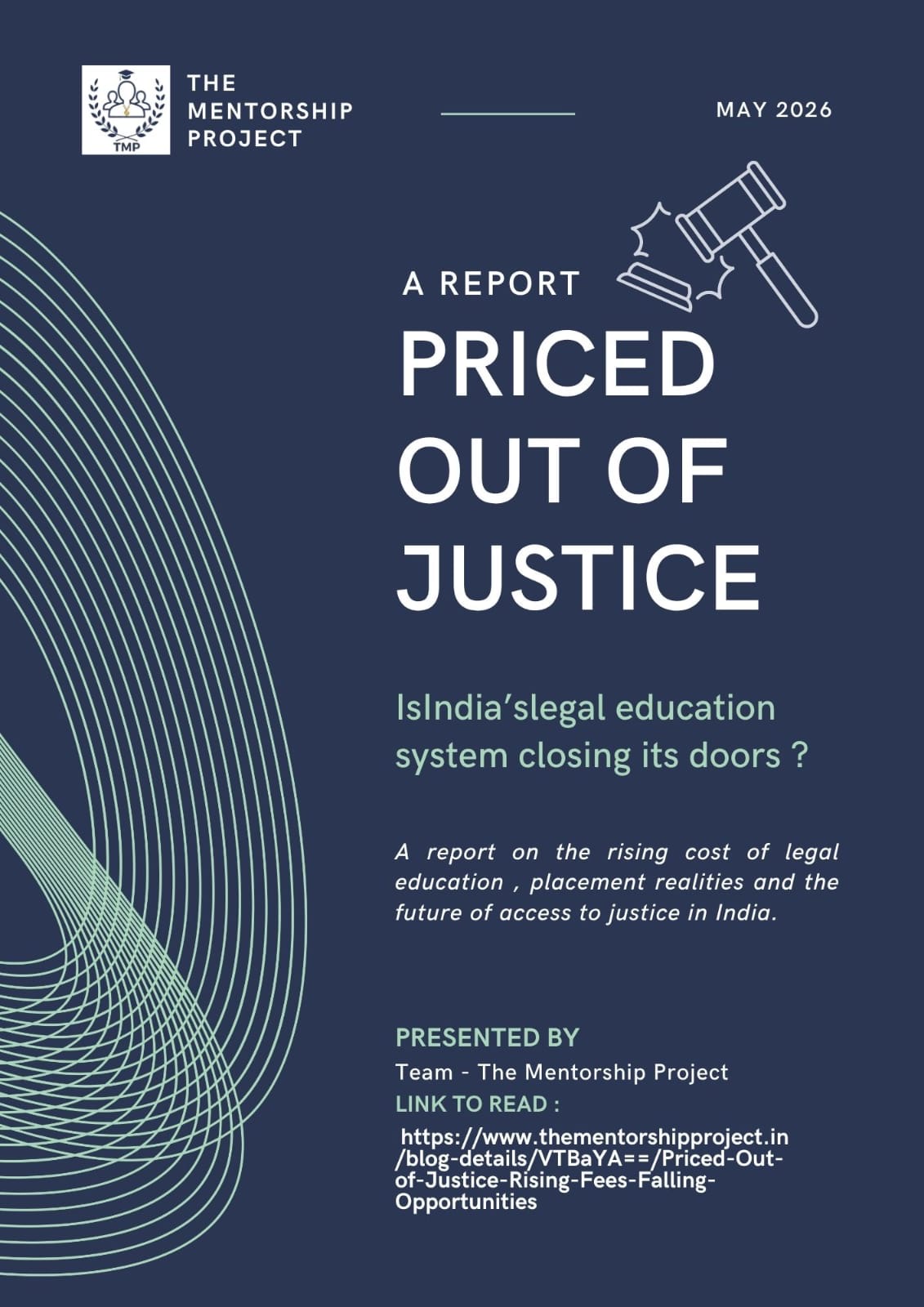
Priced Out of Justice: Rising Fees, Falling Opportunities
How soaring tuition fees, phantom placements, and a broken regulatory framework are turning India’s dream of a legal career into a debt trap for the many—and an exclusive club for the few.
"A Special Report by The Mentorship Project (TMP) on Legal Education in India"
In a country where access to justice is enshrined as a constitutional value, the profession tasked with delivering it is quietly erecting a wall of wealth. Legal education in India—once a modest, accessible ladder for the bright and the determined—has been rapidly transformed into a high-stakes, high-cost gamble, where the price of entry rises every year while the probability of a liveable return plummets. The dream of becoming a lawyer is increasingly reserved for those who can absorb losses worth lakhs, leaving behind everyone else.
This report draws on data from the National Institutional Ranking Framework (NIRF), Bar and Bench, the Bar Council of India (BCI), and academic research to map the full contours of the crisis—its causes, its consequences, and the reforms that could still rescue a system in distress.
The Tuition Spiral: A Numbers Story
The headline numbers are stark. The average annual academic fee at a National Law University (NLU) stood at Rs.1,86,392 in 2023 and has climbed to Rs. 2,20,747 in 2026—an increase of over 20% in just three years. [1] This increase is not matched by any commensurate rise in the earning capacity of the families that aspire to send their children to these institutions.
At the apex, NLSIU Bengaluru, India’s most prestigious law school, charges tuition of around Rs.15 lakh over five years, while Jindal Global Law School (JGLS) in Sonipat demands over Rs. 35 lakh in tuition fees alone for the full programme. [2] When hostel, mess, coaching for CLAT, study materials, and incidental expenses are factored in, a private law school education can consume Rs. 50 lakh or more over five years.
|
Institution Type |
Annual Tuition Range |
5-Yr Total (Approx.) |
Example |
|
Government / Old University Law Depts. |
Rs.10,000 – Rs.52,000 |
Rs.50,000 – Rs.2.5L |
Faculty of Law, Delhi University |
|
National Law Universities (NLUs) |
Rs.1.5L – Rs. 3L |
Rs.7.5L – Rs.15L |
NLSIU, NLU Delhi, NALSAR |
|
Mid-tier Private Law Colleges |
Rs.2L – Rs.5L |
Rs.10L – Rs.25L |
Symbiosis Law School, Pune |
|
Premium Private Law Schools |
Rs.6L – Rs.10L+ |
Rs.25L – Rs.50L+ |
Jindal Global Law School |
For context, law education in India can easily cost Rs.10–15 lakh in total, making it unaffordable for many families—and this figure is conservative when applied to the upper tier of private institutions. [3] Students from low-income households are effectively priced out before they even sit the entrance exam. The CLAT coaching industry itself—concentrated in cities—adds another Rs.1–2 lakh burden, compounding geographic and economic exclusion.
“This escalation has transformed legal education from a relatively accessible professional pathway into an increasingly elite domain, where financial capacity often determines educational opportunities more than academic merit.”
— International Journal of Law and Legal Research (IJLLR), April 2026 [4]
The Scholarship Gap: Promises and Painful Reality
Supporters of the status quo point to scholarship schemes as the safety valve for meritorious but financially stretched students. The reality, however, reveals a system riddled with under-disbursement, thin coverage, and eligibility bottlenecks.
The Ministry of Minority Affairs’ Post-Matric Scholarship scheme was allocated Rs.1,065 crore in 2023–24. Of that, Rs. 85.02 crore was actually spent in 2023–24; just Rs. 5.31 crore in 2024–25; and by 2025–26, disbursement had fallen to zero. [5] The Merit-cum-Means Scholarship for professional and technical courses—a key route for minority community students—has similarly struggled with disbursement delays.
Private scholarships are extremely narrow. The Aditya Birla Scholarship, worth Rs.1.80 lakh per annum, is available at only five NLUs, and just eight scholars are selected across all five institutions each year—a number so small as to be statistically invisible against the tens of thousands who enrol. [6] The recently launched ARRA Scholarship (2025) covers full costs but is limited to NLSIU and targets only the top 20 CLAT admits with family income below Rs. 35 lakh. [7]
The arithmetic is unambiguous: the scholarship infrastructure is a fraction of what is needed, and most students relying on financial aid fall into a void between aspiration and affordability.
The Placement Mirage: Who Actually Gets a Job?
The marketing materials of India’s law schools gleam with placement statistics, high-sounding firm names, and record packages. The reality behind the brochure is considerably grimmer—and for most graduates, irrelevant to their experience.
Seven out of the top 30 law colleges in India recorded less than 30% placement of graduating students in the academic year 2020–21, according to NIRF 2022 data. [8] These include both private and public institutions, suggesting the problem is structural, not merely institutional.
The Corporate Law Funnel: A Narrow Gate
- India’s top law firms—Cyril Amarchand Mangaldas, Khaitan & Co., Trilegal, AZB & Partners—hire approximately 400–600 fresh graduates annually from all NLUs combined. [9]
- CAM alone hired approximately 170 fresh graduates in 2025; Khaitan hired approximately 106; Trilegal hired 80 or more. [9]
- Starting salaries at these elite firms range from Rs. 15.7 lakh to Rs.23 lakh per annum—a figure cited relentlessly in the press but applying to a tiny minority. [10]
- India graduates an estimated one lakh law students per year from 1,700+ colleges. The corporate law elite absorbs barely 0.5% of annual graduates.
- The Law Minister confirmed in Parliament in December 2022 that no official data is maintained on unemployed law graduates. [11]
The placement narrative is bifurcated to the point of absurdity. At the very top, NLSIU, NLU Delhi, NALSAR, WBNUJS, median salaries hover between Rs.16 lakh and Rs. 20 lakh per annum, and these figures do make loan repayment plausible for the minority who land those roles. But those roles exist for a fraction of the graduating pool.
For the vast majority of India’s one lakh annual law graduates, emerging from the hundreds of mid-tier and low-quality colleges across the country, the employment picture is a fog of unpaid internships, junior advocacy for no stipend, and a slow drift out of the profession altogether.
Junior Advocates: The Invisible Precariat
Even for graduates who make it through a law degree and pass the All India Bar Examination (AIBE), the first years of practice represent a financial ordeal that pushes many out of the profession entirely.
Junior advocates in India traditionally work under senior advocates or in law firms for little or no fixed income during their initial years. The practice of unpaid or near-unpaid apprenticeship is so pervasive that it prompted a formal policy intervention. The Bar Council of India has recommended a minimum monthly stipend of Rs. 20,000 for junior advocates in urban areas and Rs.15,000 in rural areas during their first three years of practice. This recommendation, outlined in BCI Circular No. BCI:D:5383/2024, was formally validated in the Lok Sabha in February 2026. [12]
However, the BCI’s guidelines are advisory, not legally binding, meaning implementation is patchy and dependent on institutional goodwill. The Bombay High Court, in a June 2025 hearing, bluntly stated that no legal provision compels Bar Councils or governments to pay stipends to junior lawyers. [13] The Bar Council of Maharashtra and Goa informed the court that a stipend scheme for all junior lawyers in the state would cost Rs.155 crore per year—a cost it could not absorb, especially after enrollment fees were reduced from Rs.15,000 to Rs.600.
The human consequence is stark. A graduate who has spent Rs.15–35 lakh on a five-year degree exits into a profession that, by its own admission, cannot guarantee a Rs. 20,000 monthly income for the first three years. The debt-to-income ratio in the early career stage is, for many, simply unsustainable.
“Without financial support, talented young lawyers are forced to leave the profession for better-paying careers—a drain the system cannot afford.”
— PIL filed by Advocate Ajit Deshpande & group, Bombay High Court, 2025 [13]
The Quality Collapse: 1,700 Colleges and a Sea of Mediocrity
India now has over 1,700 BCI-approved law colleges and university law departments, with private institutions outnumbering government ones by more than two to one. [14] This rapid expansion, driven by unregulated demand and the profitability of professional degrees, has produced a paradox: more law schools than ever, less legal education than needed.
A study by the Research Foundation for Governance in India found that as per BCI norms, law colleges should have at least four core full-time teaching staff in Year 1, rising to eight by Year 3. None of the colleges surveyed met this criterion. 90% did not even have an appointed principal, operating instead under in-charge principals. [15] Faculty shortages are endemic, library resources often non-existent, and clinical legal education—the practical training that produces competent courtroom lawyers—largely absent.
Recognising the crisis, the BCI in 2025 imposed a three-year moratorium on approvals for new law colleges, citing the decline in quality attributed to commercialisation, faculty shortages, and inadequate infrastructure. That moratorium has since been withdrawn: the Supreme Court formally recorded on 23 February 2026 that it had been done away with, and the BCI confirmed this on 5 March 2026. [16] Critics note that the episode did nothing to reform the 1,700 institutions already operating, many of which continue to charge high fees for a sub-standard product.
|
Metric |
Data Point |
|
Total BCI-approved law colleges (2025) |
1,700+ |
|
Annual law graduates |
~1 lakh |
|
Top-firm hires annually |
~550 |
|
NLU fee increase (2023–2026) |
>20% |
|
Govt. scholarship scheme disbursement (2025–26) |
Rs. 0 (zero) |
The Regulatory Vacuum
Underpinning every dimension of the crisis is a governance failure. Legal education in India sits at the intersection of two regulatory bodies—the Bar Council of India, which focuses on professional licensing, and the University Grants Commission (UGC), which governs university curriculum. The result is no unified policy, overlapping jurisdictions, and inconsistent quality standards.
The absence of a dedicated Legal Education Commission, proposed in a pending Supreme Court PIL filed by Advocate Ashwini Kumar Upadhyay, means there is no single accountable body to enforce fee rationalisation, placement transparency, or curriculum modernisation. [17] The PIL has progressed well beyond its originally scheduled September 2025 hearing: by March 2026 the Supreme Court heard it and directed the matter be listed for further consideration in April 2026, cautioning that “we can’t thrust our views” on stakeholders. The PIL also questions the duration of law degrees, arguing that the five-year integrated programme delays earning capacity into the mid-twenties and should be restructured in line with the National Education Policy 2020’s emphasis on flexibility and early employability.
Bar Council enrollment fees add one final indignity. Some state bar councils charge as much as Rs. 40,000 as enrollment fees for new graduates wishing to practise. While the Supreme Court made a non-binding observation in May 2023 that such fees should be no more than Rs. 600, the definitive legal position was settled by the Supreme Court’s binding July 2024 judgment in Gaurav Kumar v. Union of India, which capped enrollment fees at Rs.750 for general category advocates and Rs.125 for SC/ST advocates under Section 24 of the Advocates Act. [18] Despite this, state bar councils continue to charge far more: in Tamil Nadu the fee stands at Rs.14,000; in Odisha it crosses Rs. 40,000. [19] The BCI has itself sought Supreme Court approval to raise its own enrollment fee from Rs.750 to Rs. 25,000 for general category candidates—a proposal that, if approved, would add yet another financial hurdle at the profession’s entry gate. [20]
The Way Forward: A Seven-Point Reform Agenda
1. Statutory Fee Regulation. Mandate BCI-set annual fee caps for all law colleges, with differential limits for government, NLU, and private categories, reviewed every three years.
2. Legal Education Commission. Establish a dedicated statutory commission to unify BCI and UGC oversight, enforce quality norms, and publish annual placement accountability reports.
3. Mandatory Junior Stipend. Legislate the BCI’s Rs. 20,000/Rs.15,000 stipend recommendation into law via an amendment to the Advocates Act, 1961, with penalties for non-compliance.
4. Placement Transparency. Require all law colleges to publish audited, granular placement data, median salary, percentage placed, sectors, as a condition of BCI recognition renewal.
5. Scholarship Disbursement Reform. Ring-fence allocated scholarship funds for legal education; introduce direct-benefit-transfer mechanisms to prevent the zero-disbursement failures seen in 2025–26.
6. Uniform Enrollment Fee. Enforce the Supreme Court’s July 2024 binding judgment capping enrollment fees at Rs.750 for general category and Rs.125 for SC/ST advocates across all state bar councils, and resist the BCI’s proposal to raise the central enrollment fee to Rs. 25,000.
7. Clinical Legal Education Mandate. Require all BCI-approved colleges to provide structured clinical training and moot court programmes as a precondition for recognition, improving employability and professional competence simultaneously.
Justice Cannot Be a Luxury Good
India’s legal profession is the custodian of its constitutional promises—access to justice, equality before the law, protection of rights. A system that prices the aspiring custodians out of their own training betrays those promises at the root. When the cost of a law degree exceeds the lifetime earnings of the families who most need legal representation, and when that degree yields no employment for the majority who pursue it, the profession stops serving the public and begins serving only itself.
The data is unambiguous. Fees at India’s premier law institutions have risen by over 20% in three years. Scholarship disbursement has collapsed to zero at the central level. Junior advocates cannot be guaranteed Rs. 20,000 a month. Seven of the top 30 law colleges place fewer than 30% of their graduates. And the government does not even track the unemployment of the one lakh people who graduate with law degrees every year.
Reform is not optional—it is overdue. The decisions made in the next few years, in Parliament, in the Supreme Court, and within the BCI, will determine whether India’s legal profession widens its doors or narrows them permanently into the province of the privileged few.
Disclaimer*
This report is a research-based publication compiled from publicly available data. The fee figures, placement statistics, and scholarship data cited reflect information available at the time of publication and may be subject to revision. The purpose of this report is solely to present a factual overview of publicly documented trends and developments in Indian legal education. Readers are advised to refer to official sources and institutional statements for the most current information.
References
1. Bar & Bench, “NLU Fee Analysis, 2023–2026”. www.barandbench.com
2. NIRF Rankings 2024–25, “Law Institutions Fee Data”. www.nirfindia.org/rankings
3. IJLLR, “Cost of Legal Education in India,” April 2026. ijllr.com
4. IJLLR, “Access and Equity in Legal Education,” April 2026. ijllr.com
5. PIB Delhi, “Ministry of Minority Affairs, Post-Matric Scholarship disbursement data”, 2023–26. pib.gov.in
6. Aditya Birla Scholarship Programme, Official criteria and coverage. www.adityabirlascholars.net
7. Bar & Bench, ARRA Scholarship, Rosy Blue Foundation, launched May 2025. www.barandbench.com
8. NIRF Rankings 2022, Placement Data, Law Institutions. www.nirfindia.org/rankings
9. Bar & Bench RecTracker , “Campus Recruitment, Batch of 2025 (CAM, Khaitan & Co., Trilegal)”. www.barandbench.com
10. Bar & Bench, “Starting Salaries at Top Indian Law Firms, 2025.” www.barandbench.com
11. Lok Sabha Debates, December 2022, Statement by the Law Minister on unemployed law graduates. loksabha.nic.in
12. PIB Delhi, BCI Circular No. BCI:D:5383/2024 on junior advocate stipends; Lok Sabha confirmation, February 2026. pib.gov.in
13. LiveLaw, “Bombay High Court hearing on junior advocate stipends”, June 2025; PIL by Advocate Ajit Deshpande & group. www.livelaw.in
14. Bar Council of India, List of BCI-approved law colleges, 2025. www.barcouncilofindia.org
15. Research Foundation for Governance in India, Survey of BCI norms compliance. Reported in Careers360 and LawBhoomi. www.careers360.com
16. LiveLaw, “Supreme Court records withdrawal of BCI moratorium”, 23 February 2026; BCI confirmation, 5 March 2026. www.livelaw.in
17. LiveLaw / SCCOnline, Supreme Court notice on PIL by Advocate Ashwini Kumar Upadhyay; heard March–April 2026. www.livelaw.in
18. Supreme Court of India, “Gaurav Kumar v. Union of India, July 2024”. SCCOnline. www.scconline.com
19. ThePrint / LiveLaw, State Bar Council enrollment fee survey, 2024–25. theprint.in
20. Bar & Bench, “BCI petition to Supreme Court seeking increase in central enrollment fee to Rs. 25,000”. www.barandbench.com