May 29 , 2026
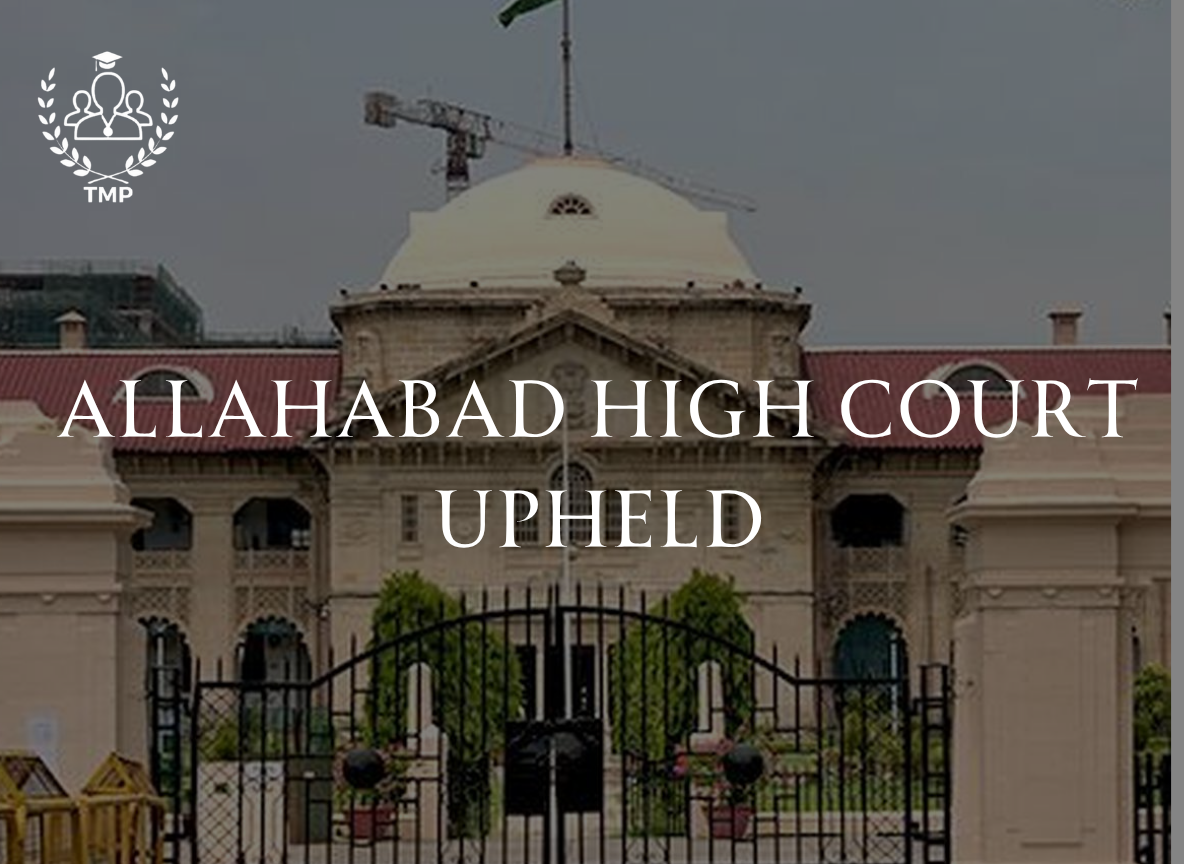
Seniority Rights Accrue Only After Appointment: Allahabad High Court Restores Challenge to Faulty Seniority List in Ashok Kumar Yadav v. Union of India
In Ashok Kumar Yadav and 2 Others v. Union of India and 2 Others, the Allahabad High Court addressed significant questions concerning service law, seniority rights, and the scope of judicial review. The petitioners, trained railway apprentices from the 1986–1989 batch, had secured higher marks than another candidate who was appointed earlier despite his lower merit ranking. After prolonged litigation before the Central Administrative Tribunal, the Delhi High Court, and the Supreme Court, the petitioners were eventually appointed in 2013 and regularized in 2014. However, the Railways failed to assign them seniority according to their merit position and instead treated them as casual labourers for seniority purposes. Their challenge to the seniority list was dismissed by the Tribunal and later by the High Court on the ground of limitation. Reviewing its earlier decision, the Division Bench held that a claim regarding inter se seniority cannot arise before a person is appointed to the service. The Court observed that the petitioners' grievance crystallized only after their regularization and the issuance of the disputed seniority list. Emphasizing the duty of courts to correct orders passed under a misapprehension of material facts, the Bench recalled its previous order, set aside the Tribunal’s limitation finding, and remanded the matter to the Central Administrative Tribunal for a fresh decision on merits.
ISSUE OF LAW
The Division Bench adjudicated upon critical questions involving service jurisprudence and the limits of review jurisdiction under Article 226 of the Constitution. (I) Whether a candidate's cause of action to contest a seniority or gradation list can legally emerge before their actual appointment and regularization into the service. (II) The constitutional and legal obligation of a High Court to invoke its review jurisdiction to recall an order passed under a fundamental misapprehension of vital facts, thereby preventing a miscarriage of justice. (III) Whether technical statutory limitation parameters can be used by an employer to escape the mandatory implementation of a court directive that has already attained supreme finality.
FACTUAL MATRIX
The Apprenticeship Merit and First Litigation Round
The three petitioners (Ashok Kumar Yadav, Riaz Babu, and Chhail Behari) completed their compulsory course as Trained Railway Apprentices (1986–1989 batch) and scored higher trade test marks (445, 417, and 413.5 out of 700 respectively) than one Mohd. Niyaz, who scored only 391/700 marks. Despite scoring lower marks, Mohd. Niyaz was inducted into service as a Khalasi (Group-D) in April 1990, while the higher-merit petitioners were passed over. The petitioners successfully contested this discrimination before the Principal Bench of the Central Administrative Tribunal (CAT), New Delhi via O.A. No. 1215 of 2001. On June 3, 2002, the Tribunal ordered the railways to maintain seniority strictly according to merit and batch. The directive attained ironclad finality up to the Supreme Court of India when the Railways' challenges were sequentially dismissed by the Delhi High Court in 2012 and the Supreme Court in March 2013.
The Delayed Appointment and Dismissal on Limitation
The Railway Authorities stubbornly withheld compliance until the petitioners initiated active contempt proceedings (C.P. No. 778 of 2012). Under contempt pressure, the railways finally issued appointment orders to the petitioners on May 7, 2013, and regularized them on March 3, 2014. Upon regularization, the railways issued an unexpected blow by treating them as casual laborers/substitute employees for seniority purposes rather than ranking them by merit as trained apprentices, formally circulating a faulty seniority list on October 13, 2015. The petitioners promptly approached the CAT, Allahabad via O.A. No. 330/00624/2016. However, the Tribunal dismissed the case as "hopelessly barred by time," reasoning that the cause of action arose back in 1990 or 2002. The High Court subsequently affirmed this dismissal via a writ order dated May 16, 2019. The petitioners then filed the present review application.
JUDGMENT
The Division Bench allowed the review application, recalled its 2019 dismissal order, and restored the original writ petition, holding that both the Tribunal and the previous High Court bench committed a patent error by assuming the cause of action arose in 1990 or 2002. Justice Tripathi noted that a person who has not even been inducted into a cadre cannot possibly have a cause of action regarding inter se seniority within that service. The actual right was violated only when their seniority was incorrectly fixed following their 2014 regularization. Relying on the timeline of the hard-fought litigation spanning 2001 to 2013 (including the contempt application), the Court observed that the petitioners were exceptionally diligent and had never abandoned their claims. The 2016 O.A. was filed within roughly four months of their administrative appeal's rejection, placing it safely within limitation parameters. Relying on the landmark Apex Court precedent in S. Nagaraj v. State of Karnataka, the Bench emphasized that it is the constitutional and legal obligation of the courts to recall orders passed under a misapprehension of true circumstances to eliminate inequitable consequences. The Court set aside the Tribunal’s 2019 limitation order and remanded the original 2016 application back to the Central Administrative Tribunal for an expedited fresh hearing on merits.
ACCESS THE OFFICIAL JUDGMENT HERE
COURT
In The High Court Of Judicature At Allahabad
CASE TITLE
Ashok Kumar Yadav and 2 Others vs. Union of India and 2 Others
CASE NUMBER
Civil Misc. Review Application No. 03 of 2019 in WRIT-A No. 7653 of 2019
BENCH
Hon'ble Mahesh Chandra Tripathi, J. And Hon'ble Prakash Padia, J.
DATE OF JUDGMENT
May 21, 2026 (Neutral Citation: 2026:AHC:117629-DB)