September 27 , 2026
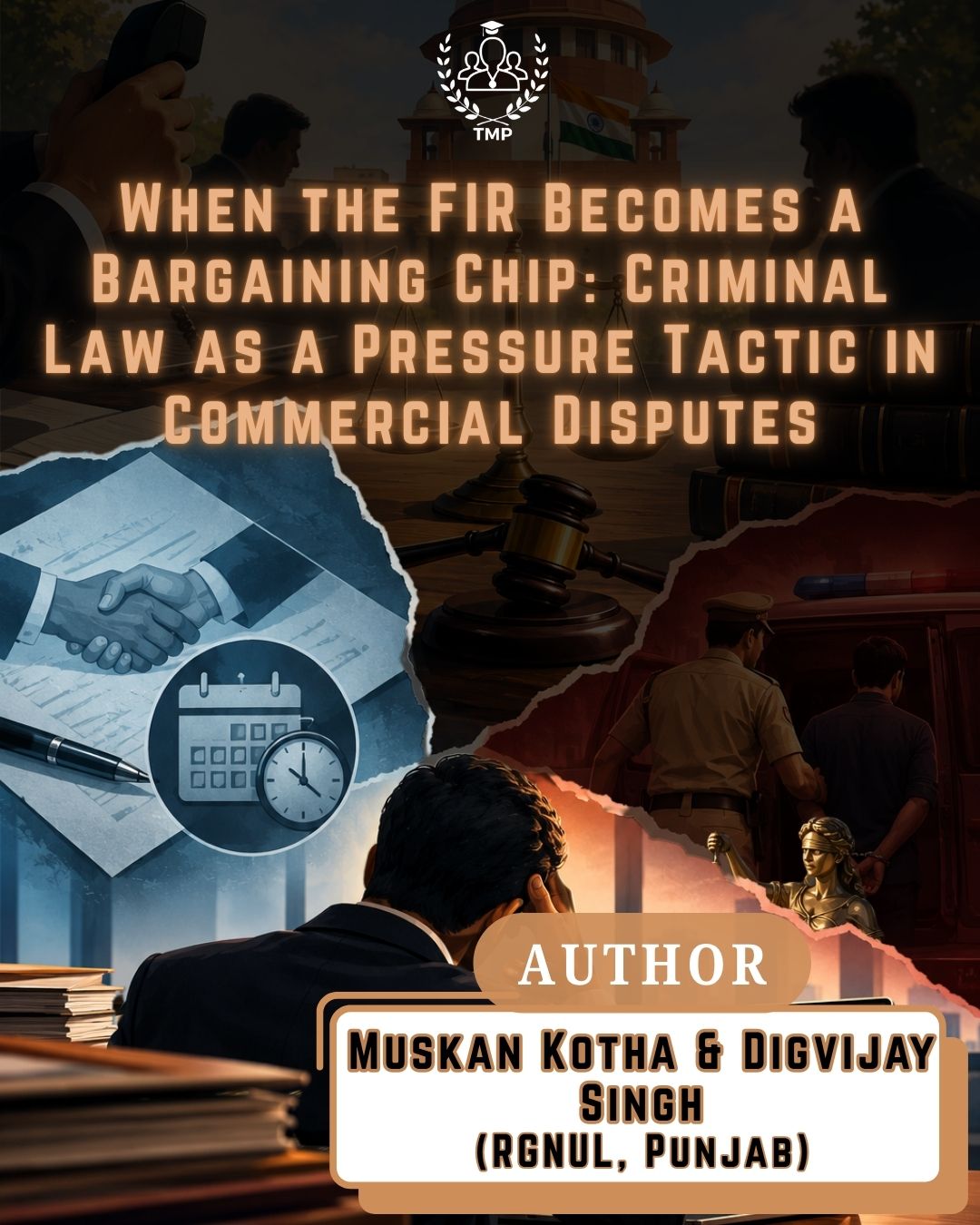
When the FIR Becomes a Bargaining Chip: Criminal Law as a Pressure Tactic in Commercial Disputes
There is a distinct type of telephone conversation that all commercial lawyers in India receive from their clients. As the negotiations over the default of payment or bad joint venture are going on, the client doesn't ask "Can we sue them?" but rather poses a question: "Can we arrest them?" There is little justice involved here. This is about using any means at the client's disposal to gain more advantage in the negotiation. And the mere fact that such calls are placed by promoters, financiers, franchisors, and landlords regularly shows the uncomfortable state of commercial disputes resolution in India - the criminal procedure becomes an extension of negotiations.
In March 2026, the Supreme Court provided the harsh rebuttal to this notion. Nazibul Rahim Khan v. State of Uttar Pradesh (2026 INSC 619) case considered an FIR filed on the grounds of forgery and impersonation in the power of attorney which was registered twenty-three years after the identical allegations were raised in the civil suit. The court did not object that there can be a simultaneous existence of criminal and civil remedy. However, the court considered this twenty-three years interval suspicious since it is impossible to make such a long pause in lodging an FIR if the same allegations had already been brought before.
This judgment is uninteresting in terms of doctrine but interesting as a message. It fits into a long list of cases where the Supreme Court has shown its frustration with parties who have tried to dress up commercial disputes in criminal clothing in order to secure settlements, asset freezes, or even just wear down their opponent. More important than the judgment is the frustration behind it, since the act of criminalizing commerce is now a structure in Indian dispute resolution.
Why Commerce Keeps Ending Up in a Police Station
The incentive structure is no mystery. A civil suit seeking recovery of money takes a decade to get to interim relief. A criminal complaint on the other hand leads to FIR being registered within days, arrest being effected within weeks and the matter finally being settled based on a chargesheet within months, with the complainant being required to prove nothing more than a prima facie case. While a civil court asks “Has the defendant breached his contractual obligation?” a criminal complaint essentially asks the police to ask “Has the defendant committed cheating, forgery or criminal breach of trust?”, and the police, which is risk averse and does not want to decide a contractual matter at the stage of registration of FIR, will often just register the FIR and leave the decision making to the courts later.
This incentive structure is being used in every commercial dispute. In case of defaulting of loans, the creditor takes a matter from being dishonored cheque matter (section 138 IPC) to be one of cheating (Section 420 IPC or section 318 of Bharatiya Nyaya Sanhita). In case of partnerships and shareholding disputes, one side alleges the other of criminal breach of trust the very day the other side gains control in the company. This is a means of using the police to do something that could have been done under oppression and mismanagement provision of the Companies Act, but much faster and at a personal cost to the accused. In case of real estate, builders and consumers exchange FIRs of forgery and cheating based on delay in possession, which in reality is a delay in contractual delivery and is triable either under the Real Estate (Regulation and Development) Act or in civil court. Supply agreement or franchise agreements lead to allegations of conspiracy immediately after termination of the distributor.
And the common element isn’t fraud. The common element is speed and the coercion of an arrest. Criminal charges bring with them considerations of anticipatory bail, travel problems, and the potential to damage your company’s reputation in the eyes of its stockholders and creditors regardless of the merit of the claim. If you’re the defendant trying to settle quickly, that’s precisely the dynamic you’re seeking.
The Doctrinal Line the Court Has Been Drawing for Three Decades
The common denominator is not fraud. It is speed and the intimidatory effect of an arrest. A director whose company is made the subject of a criminal complaint must consider anticipatory bail, possible travel bans and damage to the reputation of his company among its lenders and investors regardless of whether or not the underlying allegations are sustainable at the trial stage. For a party wishing to get a fast-track solution, it is better to take a civil recourse route rather than The Supreme Court of India has not remained indifferent to this issue. The starting point still remains State of Haryana v. Bhajan Lal (1992 Supp (1) SCC 335), which laid down the various types within which the inherent power of the High Court can be invoked to quash an otherwise abusive proceeding and one instituted with a mala fide motive for vengeance. From what Bhajan Lal listed as a number of illustrations of such types, it has gradually grown into a well settled doctrine to be applied in commercial cases: is there dishonest intention at the outset of the transaction or does the complaint merely talk about non-fulfillment of a promise?
Indian Oil Corporation v. NEPC India Ltd. (2006) 6 SCC 736 was one case where this distinction was made with uncommon clarity: absence of fulfillment of the promise, in itself, does not equate to cheating unless it is supported by some evidence of dishonest intention right at the outset of the transaction and not something inferred from subsequent events (absence of payment). In the same vein G. Sagar Suri v. State of U.P. (2000) 2 SCC 636 warns courts against using criminal processes as a substitute for civil remedies especially where a civil suit is pending. Vesa Holdings (P) Ltd. v. State of Kerala (2015) 8 SCC 293 further makes it clear that while every breach of contract does not become a criminal offense, it has to be proved that there was dishonest intention at the outset of the transaction.
The decision of Mohammed Ibrahim v. State of Bihar (2009) 8 SCC 751, for instance, has established that in a case where forgery is alleged, the fact that there is a dispute regarding a certain document will not be tantamount to forgery unless there is a false representation about the genuineness of the document. Similarly, in Uma Shankar Gopalika v. State of Bihar (2005) 10 SCC 336, a complaint alleging nonpayment of money without disclosing fraudulent or dishonest intention at the very moment the promise was made, is simply indicative of a civil wrong. In yet another recent case, Mitesh Kumar J. Sha v. State of Karnataka (2021) 14 SCC 461, the Supreme Court of India quashed the criminal complaint because the same was lodged after an unfavourable decree against the complainant in a civil court. In Neeharika Infrastructure Pvt. Ltd. v. State of Maharashtra (2021) 19 SCC 401, the apex court clarified the extent of jurisdiction of a High Court to direct stay of investigation, whereas in Randheer Singh v. State of U.P. (2021) 14 SCC 626, the said Court re-affirmed the limited jurisdiction of the High Courts to quash a case for non-bona-fides purpose.
Reading all these cases in tandem, it is clear that no bright line rule has been laid down by the Courts rather they are expected to go beyond the language of the FIR, which can always be drafted in terms of sections 420, 406, 467 or 120-B of IPC. Rather, the Courts have to analyze the chronology of events when was there first falling out between the parties, which remedy was chosen first by the complainant, whether the FIR was filed after unfavorable verdict of a civil court/arbitration? Nazibul Rahim Khan falls into this category, the important contribution of the said decision is that delay itself becomes a hallmark of mala fides intent.
Civil Wrong or Criminal Offence: A Test That Still Resists Certainty
Intellectually, the two tests, dishonest intention at the time of entering into the contract versus a breach that comes later, make sense. Very rarely will a commercial deal be accompanied with an email expressing fraud at the outset of the deal. The job of the prosecutors and investigating agencies is to ascertain the mindset of the person from behavior that took place several years after the contract was made, just what Indian Oil Corporation advised against. This means that while the law of quashing is very good indeed, its inconsistency by the trial court and police station level is problematic. An entity with money can afford to fight for quashing in the High Court and Supreme Court; the average businessman cannot.
Commercial Reality and the Cost to Governance
However, the implications go much further than the litigant alone. The possibility of being criminally charged has become an accepted part of the cost of business in India, leading to irrational risk assessment in terms of real business ventures. Due diligence by investors has resulted in criminal charges against founders which have no substance at all, but which affect funding opportunities and obtaining directors and officers insurance. For a legal system that prides itself on international competitiveness in ease of doing business and contractual integrity, it is not a good advertisement that every commercial dispute could turn out to be a potential criminal matter.
What Other Jurisdictions Do Differently
Comparative analysis helps, albeit imperfectly, in transplantation. In the United Kingdom, the Crown Prosecution Service follows the two-part "Full Code Test," consisting of evidentiary sufficiency and subsequent public interest test independently made prior to a charge, and prosecutors are trained to consider a contractual dispute with civil recourse as presumptively unsuited to prosecution absent clear evidence of fraud. Singapore similarly follows a system of centralized prosecutorial discretion which weeds out complaints which would better be dealt with in its efficient commercial courts prior to charge. In the United States, grand juries play a large role in determining what should be charged criminally, and federal and state prosecutors, unlike Indian police at the FIR stage, are permitted discretion in deciding what should be charged even before an arrest is made, often influenced by civil litigation. In Australia, through the Director of Public Prosecutions' prosecution guidelines, it similarly asks whether prosecution is in the public interest regardless of a complainant's commercial motivation. The common structure between all these systems is a prosecutorial layer between complaint and arrest, something not present in India, where the discretion to refuse registration of a complaint under Section 154 CrPC (now Section 173 BNSS) by a police officer upon receipt of a cognizable offense is limited following Lalita Kumari v. Government of U.P. (2014) 2 SCC 1.
The Constitutional Stakes
This is more than a mere procedural difficulty. The right to personal liberty in Article 21 is brought into play the moment the filing of an FIR makes possible the arrest of the accused, and even the judicial practice of the Supreme Court, post Arnesh Kumar v. State of Bihar (2014) 8 SCC 273, recognizes the act of arrest to be an invasion of personal liberty that is best avoided whenever possible. Similarly, the prohibition of arbitrariness under Article 14 is brought to bear when parties engaged in similar commercial disputes get differently treated depending upon which party files its case first and how skillfully it prepares its petition. Judicial restraint in exercising the power to quash proceedings under erstwhile Section 482 Cr.P.C. or Section 528 of the Bharatiya Nagarik Suraksha Sanhita, is not just about procedure. It is where constitutional protection of due process meets coercive commercial realities.
A Candid Assessment: Are the Safeguards Working?
Partially, yes; and to varying degrees. As Nazibul Rahim Khan makes clear, the Supreme Court is itself exemplary on both counts; its jurisprudence is both sound and increasingly fine-tuned. High Courts, meanwhile, are far more mixed, as cases under Section 528 BNSS tend to drag on for years and the accused party continues to face the threat of investigation and arrest, rendering the final resolution of his quashed petition an after-the-fact remedy too little and too late to prevent the coercive objective having been achieved. The police stations, untrained and unmotivated in terms of institutional incentive to distinguish civil complaints from commercial complaints at intake stage, still continue to register FIRs in instances in which an application of basic Indian Oil Corporation principles would clearly show such FIRs to have been civil in nature. This, in essence, means that there is a disconnect between the doctrinal acumen developed by the Supreme Court and the capacity of the mechanism below it to put it into play in the right place – namely at the FIR desk.
Legislation should certainly be considered in this regard and not just judicial admonishment. A statutory pre-registration screening mechanism for complaints relating to offences of an economic nature arising out of commercial transactions, along the lines of the CPS public interest filter, could relieve the strain on the quashing power by not allowing it to shoulder all the burden post hoc. Commercial courts that now have the power of deciding upon commercial disputes of value exceeding the prescribed limit under the Commercial Courts Act, 2015 can be empowered to make a certification on the nature of such disputes prior to registration of the criminal complaint. A malicious prosecution tort, which currently exists as a civil wrong that is seldom invoked and much more rarely proven owing to the stringent requirement of want of reasonable and probable cause, requires much sharper teeth in the form of a cost sanction mechanism within the quashing regime or a statutory compensation process for malice. Corporate governance practices will also have to factor in the risk of vexatious complaints within their indemnity provisions and D&O policies. None of the above takes away from criminal prosecution for any kind of fraud.
Where the Line Actually Sits
The line that the Supreme Court has been delineating, case after case, is not between commerce and crime as two general headings, but between intent and outcome as evidentiary issues. Breach of promise is an action in the law of torts. Breach of promise without any intention of performance from the very beginning is a crime. This dichotomy sounds easy but is not. Indeed, that is why the task of drawing this line cannot be left to the police at the First Information Report stage, nor can it be left to the constitutional courts exercising their discretionary and delayed jurisdiction. It needs to be institutionally designed through better pre-registration screenings, quicker quashing of the wrongly registered, and punishment of the complainant who seeks recourse to criminal law instead of waiting patiently in civil courts. Until this design happens, cases like Nazibul Rahim Khan will have to continue as correctives to an otherwise flawed system.
*Authored by - Muskan Kotha & Digvijay, 5th year B.A. LL.B (Hons.) students at Rajiv Gandhi National University of Law, Punjab. Views expressed are personal.